SAY NO TO VALLEY LINK
Valley Link Faces a Political Wipeout
Among Elected Officials, Opponents Outnumber Supporters 149-0
Of 153 elected officials who have publicly stated their positions on the proposed Valley Link power line, 149 are opposed. 4 are undecided. And ZERO are in support.
These elected officials represent communities in the 25 affected counties in West Virginia, Virginia and Maryland.
This tally includes members of 15 county commissions that have unanimously approved resolutions opposing Valley Link. No jurisdiction has passed a resolution supporting Valley Link.
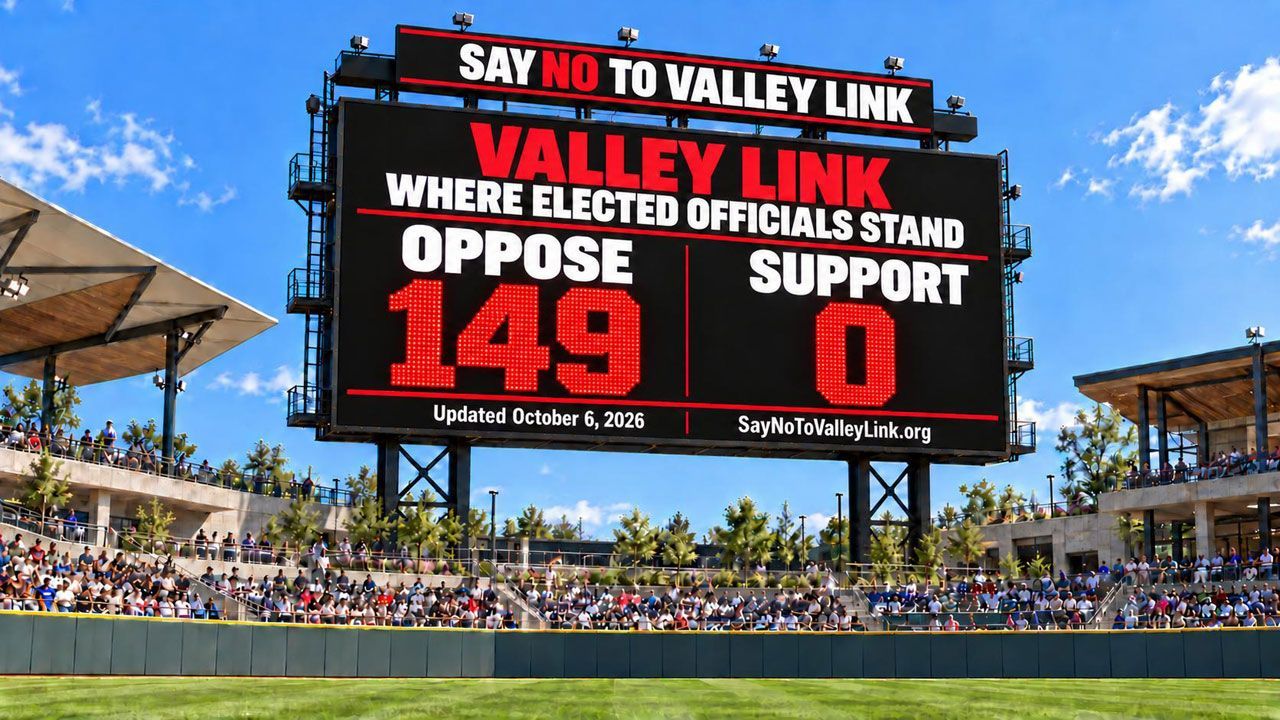
Elected officials who have yet to declare their positions are being contacted, and the tally will be updated as additional individual responses are received or other counties and cities take action.
The near-unanimous opposition to Valley Link is yet another blow to the much-maligned project. Last month a public opinion poll of residents in the 20 affected West Virginia counties showed opposition at 72%.
In a video released in late August, noted documentary filmmaker and revered interpreter of American history, Ken Burns, said Valley Link’s impact on Jefferson County and the lower Shenandoah Valley would be a “desecration.” Bass Pro Shops founder and influential
conservationist, Johnny Morris, added his voice to the "Say No To Valley Link” movement and said the power line’s impact on wildlife habitat would be “heartbreaking and irreversible.”
“I’ve followed politics in West Virginia for nearly 60 years, and I’ve never seen an issue or proposed project as discredited and reviled as Valley Link,” said Dan McGinn, one of the community organizers working against the proposed power line. “The support for Valley Link, as it’s currently designed, is undetectable. In the clearest terms possible, the public and their elected officials are telling the utility companies they need to start over. Valley Link promised to listen to the public’s views. They need to keep their word,” McGinn concluded.
SAY NO TO VALLEY LINK
In First Public Poll, 72% of West Virginians Say Valley Link Was
“A BAD IDEA FROM THE BEGINNING”
Pollster Says, “Valley Link is Seen As A Clear Threat To The Things West Virginians Value Most - Their Homes, Land, and Personal Freedom.”
The Costs Are Too Great, and The Benefits Go Out Of State
The results of a new public opinion poll, conducted in the 20 West Virginia counties impacted by Valley Link, illustrate the enormous challenge the utility companies face as they try to persuade the public of the benefits of the project.
According to noted WV pollster Rex Repass, the director of the survey, "As West Virginians learn about the proposed Valley Link 260-mile, 765-kilovolt power line, opposition grows to 70% or more."
The poll finds that a strong majority of West Virginians view Valley Link as a bad idea from the beginning and believe it is fundamentally unfair to require rural landowners to give up their property for the benefit of out-of-state data centers and other commercial interests.
The only potentially encouraging fact in the poll for Valley Link is that awareness of the project is still moderately low. Just less than 40% of residents say they know little or nothing about the proposed power line. Only 8% express strong support.
"At present, there is a moderate level of knowledge about the specifics of the plan," Repass said. "But as the public becomes more aware of the costs, their views become decisively, and resolutely negative," he added. "Damaging farms, threatening historic properties, and increasing electric bills, are widely seen as unacceptable consequences by residents in the impacted counties," according to Repass.
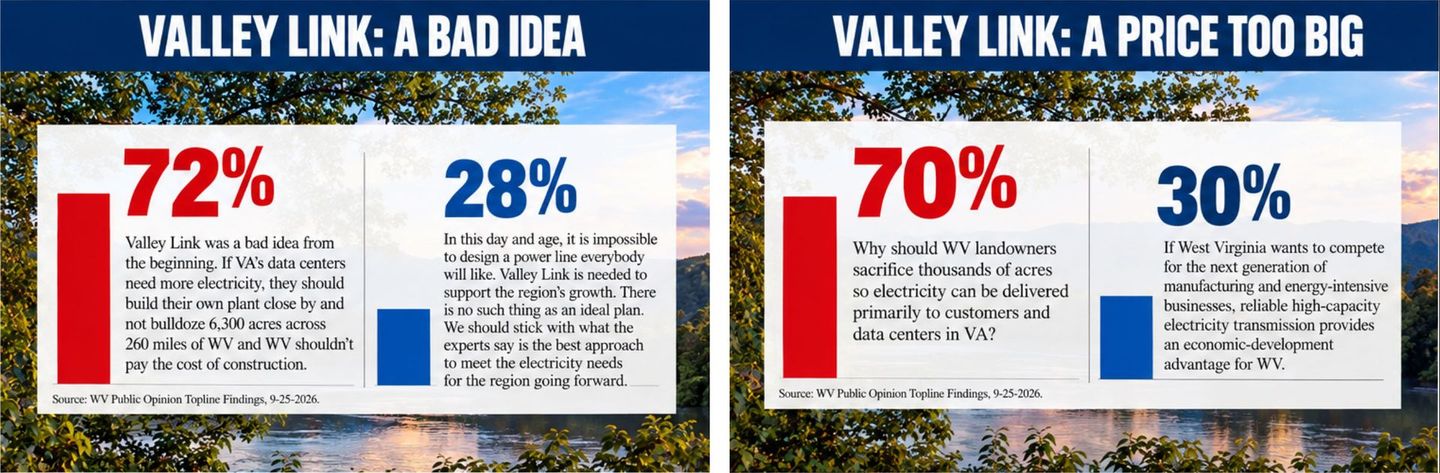
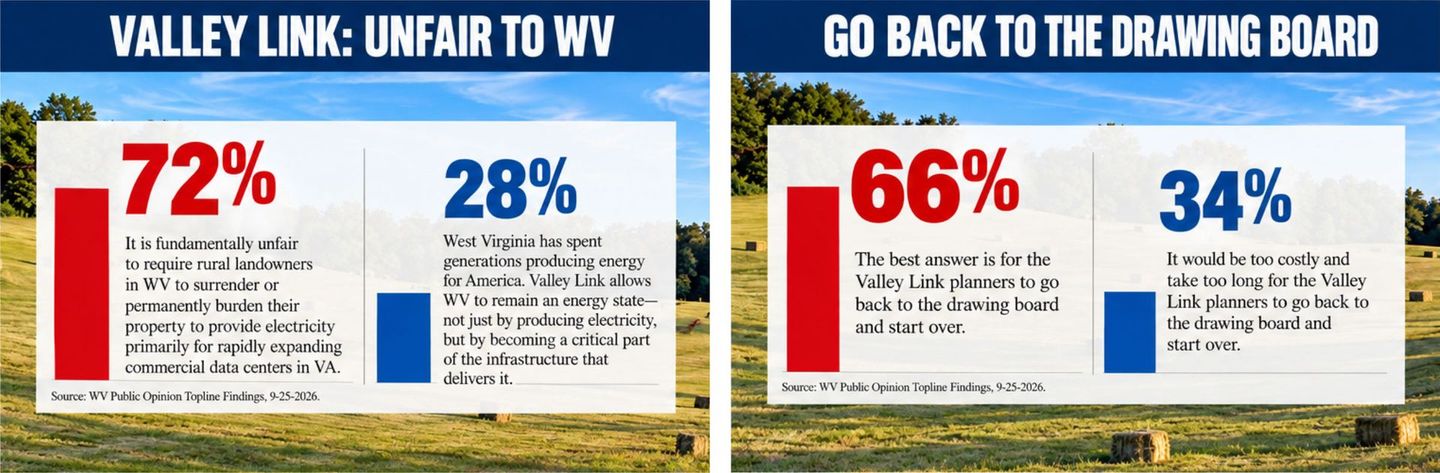
Seventy-two percent of respondents say they agree it's "fundamentally unfair to require rural landowners in West Virginia to surrender or permanently burden their property to provide electricity to primarily rapidly expanding commercial data centers in Virginia." By a similar 70-30 margin, residents agree that "Valley Link was a bad idea from the beginning." Respondents believe Virginia should "build their own power plant, not bulldoze 6,300 acres and West Virginia shouldn't pay the cost of construction."
At the heart of the opposition is a belief that the costs of the project are simply too great and that the benefits will largely flow out of state. Seventy percent of respondents agree that West Virginia landowners should not have to sacrifice thousands of acres so electricity can be delivered primarily to customers and data centers in Virginia. Related to that concern, 72% say it is fundamentally unfair to require rural landowners in West Virginia to surrender or permanently burden their property to provide electricity primarily for rapidly expanding commercial data centers in Virginia.
Residents also strongly reject the argument that the project is a good deal for the state. By a 70-30 margin, they agree that Valley Link was a bad idea from the beginning. They believe Virginia should build their own power plant, not bulldoze 6,300 acres across 260 miles of West Virginia, and West Virginia shouldn't have to pay the cost of construction.
When asked about the broader economic justification for the project, only 28% found the claim persuasive that Valley Link allows West Virginia to remain an energy state "not just by producing electricity but by becoming a critical part of the infrastructure that delivers it." Similarly, only 30% found the argument that "reliable, high-capacity electricity transmission provides an economic-development advantage for West Virginia" to be a reasonable justification.
Despite the negativity, there is one potentially encouraging sign for project supporters: awareness remains moderate. Just less than 40% of residents say they know little or nothing about the proposed power line, and only 8% express strong support. Repass noted that as the public becomes more aware of the costs, their views become decisively and resolutely negative.
"At present, there is a moderate level of knowledge about the specifics of the plan," Repass said. "But as the public becomes more aware of the costs, their views become decisively, and resolutely negative. Damaging farms, threatening historic properties, and increasing electric bills, are widely seen as unacceptable consequences by residents in the impacted counties."
As to what should happen next, 66% believe "the best answer is for Valley Link planners to go back to the drawing board and start over."
"Numbers like these are impossible to ignore," Repass commented. "If I were advising Valley Link, and I've spent decades in boardrooms debating tough issues, I would tell the executive team that they should listen carefully to the public on these issues. The core problem with the Valley Link plan is that it's perceived to be disrespectful. Homes are taken, farms damaged or destroyed, costs imposed, and the benefits are seen as going out of state."
"This is not a public relations or marketing problem. The issues are deeper and tied directly to the framework of the plan itself. No amount of repackaging or re-explaining will overcome these hard feelings. I know the people of WV, I have learned to respect their judgment and their resolve. Valley Link is seen as a clear threat to the things West Virginians value most," Repass concluded.
Rex Repass BIO
A native of Charleston, West Virginia, Rex Repass is a veteran public opinion researcher and entrepreneur. He is the founder of The West Virginia Poll™, a media sponsored public opinion survey started in 1980. He began his business career in West Virginia in the late 1970s. In 1988, Rex joined MarketVision Research in Cincinnati as senior vice president and shareholder. In 2001, he sold his interest in MarketVision and formed R.L. Repass & Partners Inc. in Cincinnati.
In 2016, Research America Inc. acquired Rex's company and he was named president. Today he maintains a consulting relationship with the Philadelphia-based firm. On four separate occasions, Rex's businesses received Inc. magazine's award as one of the fastest growing privately held companies in America. During his 45-year career, he has directed more than 500 opinion research projects in West Virginia on behalf of corporations, trade associations, media entities, government agencies, and non-profits.
Rex received a Master of Science degree from the University of Tennessee and a Bachelor of Arts degree from Marshall University. In 2017, he received Marshall University's College of Arts & Media Award of Distinction.
Methodology Statement
This survey was conducted among adults aged 18 plus residing in one of 20 counties where the Valley Link Transmission Line project is being planned beginning in Putnam County and continuing through Jefferson County in the Eastern Panhandle. The sample was stratified to include an approximate demographic profile of residents of the affected area. A total of 400 surveys were completed online between Sept. 15-24, 2026. The overall statistical confidence interval for the total sample is +/- 4.9 percentage points at the 95 percent confidence level.
CONTACT:
Dan McGinn - Say No to Valley Link
Cell-703-447-8710
Mara Vandlik
WEST VIRGINIA OPINION POLL
5 Questions About the Valley Link Opinion Poll
A new survey of residents in the 20 West Virginia counties affected by the proposed Valley Link power line finds substantial opposition to the project. The findings also suggest that opposition increases as residents learn more about the proposal.
1...What was the purpose of this research?
There has been a lot of discussion in West Virginia and nationally about the growing demand for energy, especially as it relates to data centers. The proposed Valley Link power line highlights these issues in the state, so we conducted a survey in the 20 affected counties to determine how residents feel about the benefits and risks of the project.
2...What were your key finding?
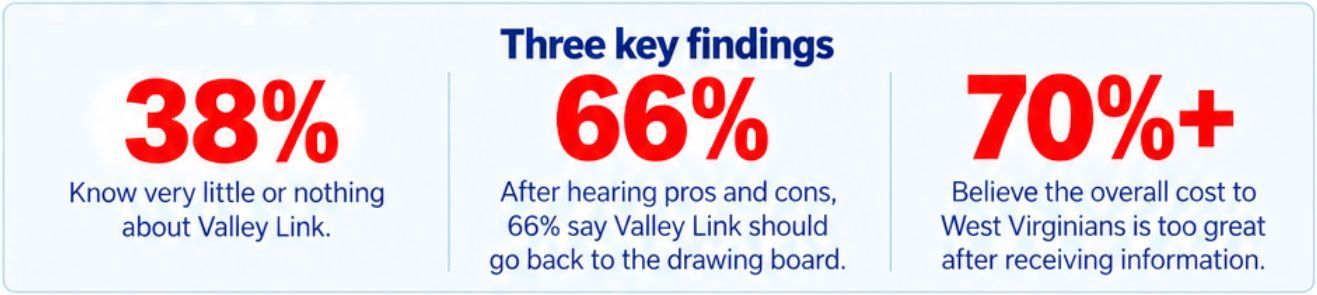
There were three key findings:
- First, the details of the Valley Link project are only moderately well known. 38% of respondents say they know very little or nothing about Valley Link.
- Second, after hearing pros and cons, 66% say Valley Link should go back to the drawing board.
- Third, when information is shared for and against Valley Link, opposition to the power line soars. More than 70% believe its overall cost to West Virginians is too great.
3...How should Valley Link interpret this data?
It's my job to be objective and factual. That's what I've always done with clients. But it's common after a research presentation for a client to ask me what I think they should do in response to the data. If I were in a boardroom with Valley Link executives, I would tell them this is a classic "good news, bad news" situation.
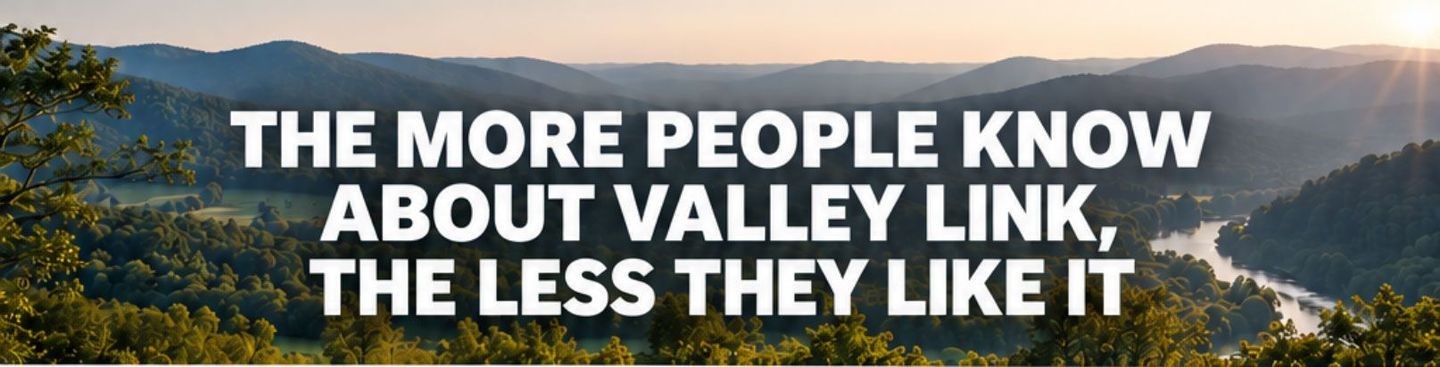
The good news is the public is still in the early stages of learning about Valley Link. The bad news is the more they learn about the various "costs" of the project, the less they like it.
Speaking bluntly, the more the public learns about Valley Link, the more they passionately dislike it.
4...What's your message to the "Say No To Valley Link"?
Their clear objective is to build awareness. As people learn about the plan to bulldoze 6,000-plus acres, damage or destroy farms, threaten historic sites and potentially imperil water resources, opposition grows and hardens.
Add in the fact that the principal beneficiary is data centers in Virginia, but West Virginians will have to pay the bulk of the costs, and it's easy to see why the public is saying Valley Link needs to go back to the drawing board.
5...What can Valley Link do to win popular support for this project?
Speaking as objectively as I can, I don't think this is a communications problem for Valley Link. In fact, I would caution them against making that assumption.
I've been doing surveys in West Virginia for more than 45 years. I know and trust the judgment of everyday West Virginians on matters that relate to their homes, families and state pride.
I don't believe the plan, as it's currently framed, will ever gain public support. To the contrary, I would expect views to harden and passions to grow.
CONSERVATION ACTION ALERT:
SPECIAL MESSAGE FROM JOHNNY MORRIS, NOTED CONSERVATIONIST AND FOUNDER OF BASS PRO SHOPS CONCERNING THE PROPOSED VALLEY LINK PROJECT IN WEST VIRGINIA AND THE LOWER SHENANDOAH VALLEY
PLEASE BECOME INFORMED AND SHARE WITH YOUR FAMILY AND FRIENDS - TAKE ACTION NOW!
"Almost Heaven, West Virginia..." Any time we hear John Denver's heartwarming song, we're transported back to mornings watching the mist rise off the Blue Ridge and feeling the soft current of the Shenandoah beneath a drift boat. Everyone who has ever hunted, fished, hiked, or camped in this cathedral of nature knows in their bones that this is one of the most Wild and Wonderful places on God's great earth.
That is why we were shocked and saddened to learn about a proposal by Valley Link for a 260-mile, 765-kilovolt transmission line that would clear-cut over 6,300 acres across 20 West Virginia counties, part of the Shenandoah Valley, terminating in Frederick County, Maryland. This would rip through a place where life is truly "older than the trees"—living waters, ancient timbered ridges, historic battlefields, and family farms, some of which have been in the same family since the 1700s.
A thought shared by many of our customers gets right to the point: there has to be a better way.
As Americans, we all know reliable electricity and energy security are vital to our economy and our communities. But progress cannot come at the expense of flattening centuries-old family farms, fragmenting vast stretches of forest, and scarring hallowed ground we cherish, including Civil War battlefields and properties owned by George Washington's family. The proposed route cuts directly through timberlands that provide habitat for white-tailed deer and wild turkeys, and impacts waters celebrated for smallmouth bass and alive with bald eagles and blue herons. Once you carve a 200-foot-wide industrial path and erect 180-foot-tall towers throughout these woods and waterways, the damage is heartbreaking and irreversible.
As fellow sportsmen and conservationists, we can all be proud of what we've done together to champion conservation and defend our sporting heritage. Before tearing through unspoiled land, utility partners and regulators owe it to future generations to consider other less damaging routes. And we must exhaust every modern, common sense, low-impact engineering alternative. By utilizing existing disturbed rights-of-way, upgrading current transmission corridors with advanced conductors, and exploring underground technologies where appropriate, we can power America without triggering one of the largest clear-cutting endeavors in West Virginia history.
We are inspired by and feel deeply compelled to stand steadfast alongside the landowners, sportsmen and women, farmers, and community leaders who are rising up to conserve one of America's most iconic wild landscapes. We're honored to join with our friends in West Virginia, Virginia, and Maryland, who are urging public authorities to reject this currently proposed route and method and go back to the drawing board. We hope you'll stand alongside us to honor and protect the birthplace of Country Roads.
Let's stand united. We are proud to stand steadfast beside you in conservation, together we can continue to make a big difference.
AN OPEN LETTER
VALLEY LINK MUST NOT BE ALLOWED
TO DESTROY "COUNTRY ROADS"
Bill Danoff, songwriter of "Take Me Home Country Roads"
To My Mountaineer Friends,
Almost Heaven, West Virginia
Blue Ridge Mountains
Shenandoah River
I wrote those lyrics over 55 years ago, and with Taffy Nivert and John Denver, we recorded “Take Me Home Country Roads.” We thought we had a good song, but we had no idea it would become the global sensation it is today.
This past summer, I was amazed and touched as “Take Me Home Country Roads” became the unofficial anthem for the U.S. team during the World Cup. I loved watching 65,000 fans singing our song. I only wish I could have watched one of the games with John as I know he would have been thrilled as well.
“To bludgeon the land that’s honored in our song…would be a travesty.”
As happy as I was with the World Cup celebration, I’m equally sad to learn of a plan by Valley Link to build a massive power line through the heart of Jefferson County, WV, the inspiration for “Take Me Home Country Roads.”
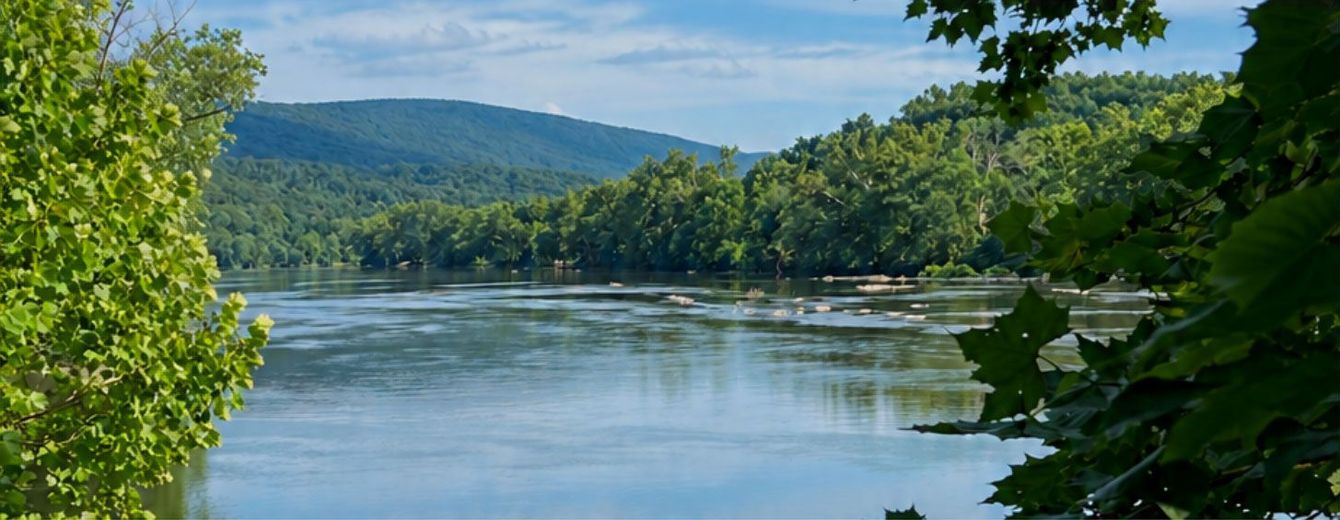
West Virginia is an under-appreciated paradise, and the area of Jefferson County where the Blue Ridge Mountains briefly touch the Shenandoah is one of our nation’s crown jewels. To bludgeon the land that’s honored in our song by installing a 260-mile, 765-kilovolt power line would be a travesty.
Our song is sung in villages in Africa, beer halls in Germany and wedding parties in Russia. The accents are different, but the words, and the feelings are the same. We all want to honor the place we call home.
For most people, “Take Me Home Country Roads” is a metaphor for going home.
In Jefferson County, West Virginia, it is home.
There are any number of places where a power line could be built.
The inspiration for “Country Roads” shouldn’t be one of them.
We have to Say NO To Valley Link.
Always a Mountaineer in Spirit,
Bill Danoff
COUNTRY MUSIC HALL OF FAMER, MARTY STUART, RELEASES TRIBUTE TO FARMERS FIGHTING VALLEY LINK
LEGENDARY DOCUMENTARY PRODUCER, KEN BURNS,
JOINS THE FIGHT AGAINST VALLEY LINK POWER LINE
SAY NO
TO VALLEY LINK
Say NO to higher electric bills
Say NO to bulldozing Jefferson County
VALLEY LINK: THE BASICS
765 kilovolts. 260 miles. 6600 acres bulldozed.
Hundreds of Jefferson County homes and farms destroyed.
Towers the size of 14-18 story buildings.
Higher electric bills for every resident and business.
DATA CENTERS ARE THE PRIMARY BENEFICIARY
Learn more and read the Valley Link proposal at:
OUR MISSION:
STOP VALLEY LINK
WHY THIS MATTERS
- Valley Link will destroy hundreds of Jefferson County homes, farms and fields.
- It will desecrate our historic areas.
- It will increase electric bills for every Jefferson County resident and business.
THIS IS A NON-PARTISAN CAMPAIGN
- Valley link has done the seemingly impossible: It’s united our community and people across WV, MD and VA.
THE BOTTOM LINE
- Valley Link is designed to bring power to Loudoun County’s data centers.
- Loudoun County is the wealthiest county in America.
- The AI-data center industry are the richest corporations in the world.
WHY SHOULD WE SACRIFICE OUR FARMS AND HISTORY AND PAY HIGHER ELECTRIC BILLS FOR LOUDOUN COUNTY'S DATA CENTERS?
5 FACTS YOU NEED TO KNOW:
Fact 1
A 765 KV Tower Can Reach 170 ft
Fact 2
Loudoun County collects
$110 MILLION PER MONTH
in
property taxes from data centers
Fact 3
The plan would
BULLDOZE 6,600 ACRES
of farms, fields, homes, & forests
Fact 4
70% OF AMERICANS
oppose constructing data centers
in their home communities
Fact 5
Loudoun County’s 200 data centers
consumed more energy than all of Virginia’s
3.4 MILLION HOMES
DATA CENTER MORATORIUMS SWEEP THE NATION
MORE THAN 160 LOCAL GOVERNMENTS HAVE ACTED
JOIN THE CAMPAIGN
JOIN THE CAMPAIGN
Subscribe to our newsletter for project updates, meeting notices,
local stories, and practical ways to help.